
1. When should I start planning for U.S. college admissions?
Starting early, ideally in 8th, 9th, or 10th grade, gives you more time to build a stronger profile, explore your interests, and unlock greater scholarship opportunities.
2. What’s included in Mentus College Consulting’s services?
Our guidance covers every step of the U.S. college admissions journey, from early career counseling and college list creation to essay editing, application review, and scholarship strategy. We also provide educational mentorship services to help students stay focused and make informed academic choices throughout the process.
3. Does Mentus assist students across the globe?
Yes! We have a dedicated team that proudly assists with the US college end-to-end application process.
4. How does early college planning help save costs by earning a scholarship?
Starting early can strategize the 4 years of high school, for a standout application, ensuring immense scholarship potential.
5. What students should do to prepare for U.S. college admissions?.
- Take college prep classes
- Focus on grades and GPA as a freshman, not waiting until junior or senior year
- Explore and commit to a few extracurricular activities
- Take on leadership roles in clubs, sports, organizations, etc.
- Seek out internships
- Regularly meet with your guidance
- Counselor to stay on track
- Start saving for college!
6. Factors to consider while making a college list.
Admissions experts encourage students to consider these questions as a starting point when creating a college list. A comprehensive set of questions will vary based on student priorities.
- Does the college have my intended major?
- What financial aid is available?
- What are the net costs after financial aid?
- Are there opportunities for internships or undergraduate research?
- What is the average class size?
- What kind of academic experience am I looking for?
- Does the college offer extracurricular activities that interest me?
- What housing options are available?
- What are retention rates for first-year students?
- What are the graduation rates?
- What are the graduation rates for students by income level?
- What are the job-placement rates for students in my intended major?
- Will this college allow me to express my cultural or religious identity comfortably?
7. What are the characteristics of an ideal candidate?
- Has taken well-rounded classes
- STEM experience
- Hopeful entrepreneur
- Social justice activist
- Literary scholars
- Talented athlete
- Maturity
- Commitment and dedication
- High-level writer
- Confident, prepared and organized public speaker
- High grades
- High test scores
- Community service experience
8. SAT or ACT?
SAT
TEST INFORMATION: SAT
Section | Time Allotted (minutes) | Number of Questions/Task |
Reading and Writing | 64 (two 32 minutes modules) | 54 |
Math | 70 (two 35 minutes modules) | 44 |
Total | 134 | 98 |
MAJOR Features: SAT
Total Testing Time | 2 hours 14 minutes (excluding break) |
Components |
|
Important Features | Continued emphasis on reasoning, alongside a clearer, stronger focus on the knowledge, skills, and understandings most important for college and career readiness and success.
Greater emphasis on the meaning of words in extended contexts and on how word choice shapes meaning, tone, and impact.
Most of the questions are multiple choice, though some of the math questions ask you to enter the answer rather than select it.
Rights-only scoring (a point for a correct answer but no deduction for an incorrect answer; blank responses have no impact on scores). |
Structure | Each section is divided into 2 equal-length modules, and there is a 10-minute break between the Reading and Writing section and the Math section.
The first module of each section contains a broad mix of easy, medium, and hard questions.
Based on how students perform on the first module, the second module of questions will either be more difficult or less difficult. |
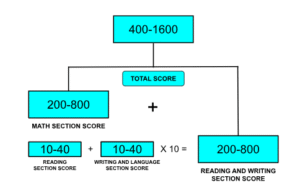
Components | Total Score: Scale ranges from 400 to 1600 Section Score: Scale ranges from 200 to 800 Cross-Test Scores: Scale range from 10 to 40 |
Your SAT Score Report
You will find your total score and your section scores on your official SAT score report from the College Board. These are the scores that college admissions committees consider when they review your application. On your SAT score report, you will also find a series of cross-test scores and subscores that analyze various proficiencies.
Redesigned SAT: Insight Scores
Composite Score: 400–1600
- Based on the sum of two main sections:
- Evidence-Based Reading and Writing (EBRW)
- Math
1. Evidence-Based Reading and Writing (200–800)
This section is divided into two tests:
- Reading
- Writing and Language
Each test measures specific skills and contributes to the overall EBRW score.
Subscores under EBRW:
- Command of Evidence
- Words in Context
- Expression of Ideas
- Standard English Conventions
Cross-Test Scores (shared with Math section):
- Analysis in Science
- Analysis in History/Social Studies
2. Math (200–800)
The Math section evaluates quantitative reasoning and problem-solving skills.
Subscores under Math:
- Heart of Algebra
- Passport to Advanced Math
- Problem Solving and Data Analysis
Cross-Test Scores (shared with Reading/Writing):
- Analysis in Science
- Analysis in History/Social Studies
Essay (Optional)
Each essay is scored by two raters, each on a 1–4 scale.
You receive three separate scores (each on a 2–8 scale):
- Reading
- Analysis
- Writing
NEW DIGITAL SAT: What’s Changed?
- Digital test delivered on tablet or computer via app
- Multi-stage adaptive technology
- One-third less adaptive technology
- One-third less total testing time
- More time per question
- Shorter reading passages with 1 question per passage
- Less wordy math questions
- Scores returned in days not weeks
- Built-in Desmos calculator available for all math questions
ACT
FORMAT OF THE ACT
Test | No. of Questions | z |
English | 75 |
|
Math | 60 | Preparing for higher math (57-60%)
Integrating essential skills (40-43%) |
Reading | 40 |
|
Science | 40 |
|
HOW IS THE ACT SCORED?
- Count the number of questions answered correctly on each subject test. No points are deducted for wrong answers!
- Raw scores (number of correct answers on each test) are converted to scale scores.
- A composite score ranges from 1-36 and is an average of the 4 test scores rounded to the nearest whole number.
- Reporting categories are released and include the total number of questions in the category, the total number of questions answered correctly, and the percentage of questions answered correctly.
ACT Score Range
Each ACT test subject, including English, Math, Reading and Science, is scored separately and then combined to form a Composite Score.
Step-by-step process:
- English Test
- You earn a Raw Score based on the number of questions answered correctly.
- The raw score is converted into a Scaled Score (ranging from 1–36).
- Math Test
- You earn a Raw Score based on correct answers.
- The raw score is converted into a Scaled Score (ranging from 1–36).
- Reading Test
- You earn a Raw Score for correct answers.
- The raw score is converted into a Scaled Score (ranging from 1–36).
- Science Test
- You earn a Raw Score for correct answers.
- The raw score is converted into a Scaled Score (ranging from 1–36).
Composite Score
- Your Composite Score is the average of the four scaled scores (English, Math, Reading, and Science).
- It is rounded to the nearest whole number and also ranges from 1–36.
Additional Details
- Each raw score represents the number of questions you answered correctly.
- There is no penalty for incorrect answers.
- The reporting categories show:
- Total number of questions in each category
- Number of questions you answered correctly
- Percentage of correct answers
9. How important is time management?
TIME MANAGEMENT TIPS
- Set your goal correctly
- Prioritize wisely
- Set a Time Limit
- Takes breaks between tasks
- Organize yourself
- Remove non-essential task
- Plan Ahead
10. What is a test-optional policy?
When universities allow all or some applicants to decide whether to submit SAT or ACT scores as part of their application. It doesn’t mean that schools aren’t interested in seeing all applicants’ performance and potential but if a student doesn’t submit their scores, it won’t be considered in the application review.
11. What is FAFSA?
The Free Application for Federal Student Aid (FAFSA) is the primary form used by U.S. colleges, universities, and the federal government to determine a student’s eligibility for financial aid.
Through FAFSA, students can access:
- Federal grants (do not need to be repaid)
- Work-study opportunities (part-time campus jobs)
- Federal student loans with low interest rates
- State and institutional scholarships or grants, since many colleges also use FAFSA data for their own aid programs
Submitting the FAFSA early is crucial, as some aid is awarded on a first-come, first-served basis and deadlines vary by state and college.
In addition to FAFSA, students should also explore university-specific and private scholarships to maximize funding opportunities and reduce college costs.